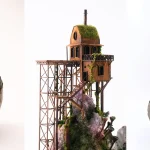
Paul Jach has spent over two decades quietly doing what most artists only dream of: building something real while never losing the thread back to making. A New Jersey art teacher, gallery founder, community organizer, and now a sculptor whose work fuses hand-carved wood with industrial metal, Paul brings the same depth to his studio practice that he has always brought to the people and places around him.
There is always a backstory with artists beyond education, before the moment of realization to create with purpose or career. What would you say that origin story or moment is for you?
After finishing art school, I never completely stopped making art, but created less consistently when I began to curate, became an educator, ran a non-profit arts organization and started a family. A moment where I realized I wanted to get back to making and showing my art more often was about three years ago when I heard an inspiring radio interview of artist Bisa Butler.
She discussed that before her art became a full-time career, she was an art teacher in an urban district in New Jersey; not far from the very similar district where I teach and grew up. She suggested starting local by participating in group shows and to network with other artists, to make art consistently and get it out there.
When I saw what a fellow NJ art teacher was able to accomplish, I had the epiphany that launching an art career while working as an educator was absolutely achievable. At that moment I decided to take a shot at it myself and put my hat in the ring. Since then I have made at least one new piece a month and shown my art at some of my dream galleries including working with Aunia and Michael at Poetic Tiger Gallery.

There seems to be an evolutionary process in your work over the years, where diversity in medium, story, and perhaps purpose emerge along a non-linear path. How would you speak about this “evolution” in process over the years for yourself?
The first major evolution in my work was going from being an illustration major in art school to working almost exclusively in sculpture and relief. This shift happened as a result of the Dog Days of Summer project that our non-profit put on in our community. Dog Days of Summer was a public art exhibit where artists were asked to work on fiberglass dog and cat sculptures to be displayed on the Main Street of our town for the summer. I had only taken one sculpture class in art school and didn’t really think it was my thing.
Dog Days made me realize that I do enjoy working in 3D and it unlocked infinite possibilities for my art. Around the same time I went back to school to get my teaching certification and took a woodworking class. I fell in love with the materials and processes, and began to incorporate industrial materials and techniques into my fine art work.

Many of your pieces invite viewers into a space that they may recognize via pop culture but also work that as in some of your recent sculptures where it embodies an emotion or symbolism in the piece. When you are making a piece, how do you decide what is revealed and what remains just out of reach?
Most often, the theme of the exhibit that the piece will be included in will guide my thought process in developing a concept. Once I have an idea, that will usually include what I want the piece to say and how literal or open to interpretation I want that message to be. Recently, I’ve been exploring common lore, fables, literature and history.
Mining concepts and stories that are from the lesser known pop-culture of the past. So if the viewer isn’t familiar with what I’m referencing, that’s going to automatically cause them to interpret the intent of the piece on their own. I don’t mind explaining my intent and inspiration for a piece, but I also love for the viewer to create their own narrative based solely on what they are seeing and feeling when viewing my work.

When you approach crafting your work, how important is storytelling in regard to the materials and the end result of the work and secondly how does your practice interact with the other parts of your daily life?
I feel each piece I make is telling some kind of a story in one way or another. I feel the materials used can be a great tool in telling that story and add subtle layers to the concept.
My daily life and the art I make are extremely interwoven. Making art can tend to distance me from my family, so I work exclusively at home. It also helps that my wife is an artist as well. So making and showing our own art has become an integrated element of our daily life. Teaching and my students can also often inspire my art, and vice versa, sometimes the art I make or a process I use may inspire a lesson or what I teach.
When you approach crafting your work, how important is storytelling in regard to the materials and the end result of the work and secondly how does your practice interact with the other parts of your daily life?
I feel each piece I make is telling some kind of a story in one way or another. I feel the materials used can be a great tool in telling that story and add subtle layers to the concept.
My daily life and the art I make are extremely interwoven. Making art can tend to distance me from my family, so I work exclusively at home. It also helps that my wife is an artist as well. So making and showing our own art has become an integrated element of our daily life. Teaching and my students can also often inspire my art, and vice versa, sometimes the art I make or a process I use may inspire a lesson or what I teach.