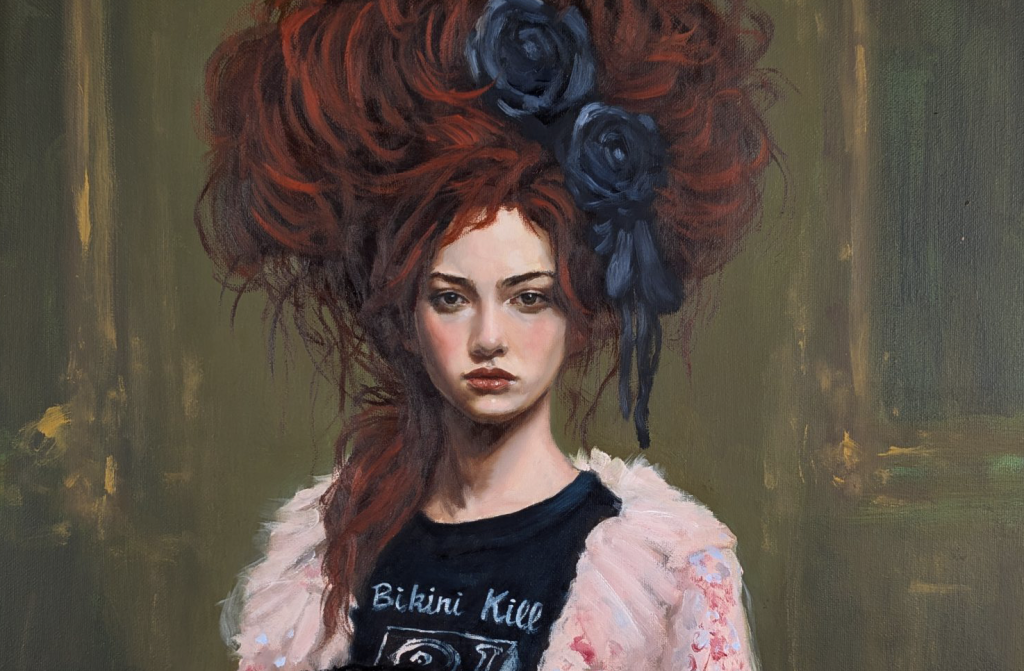
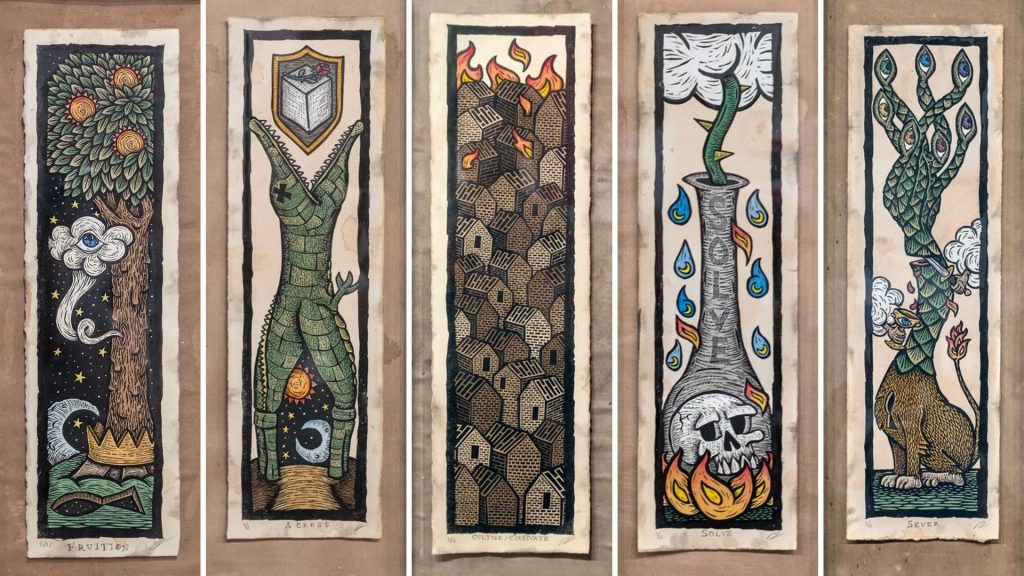
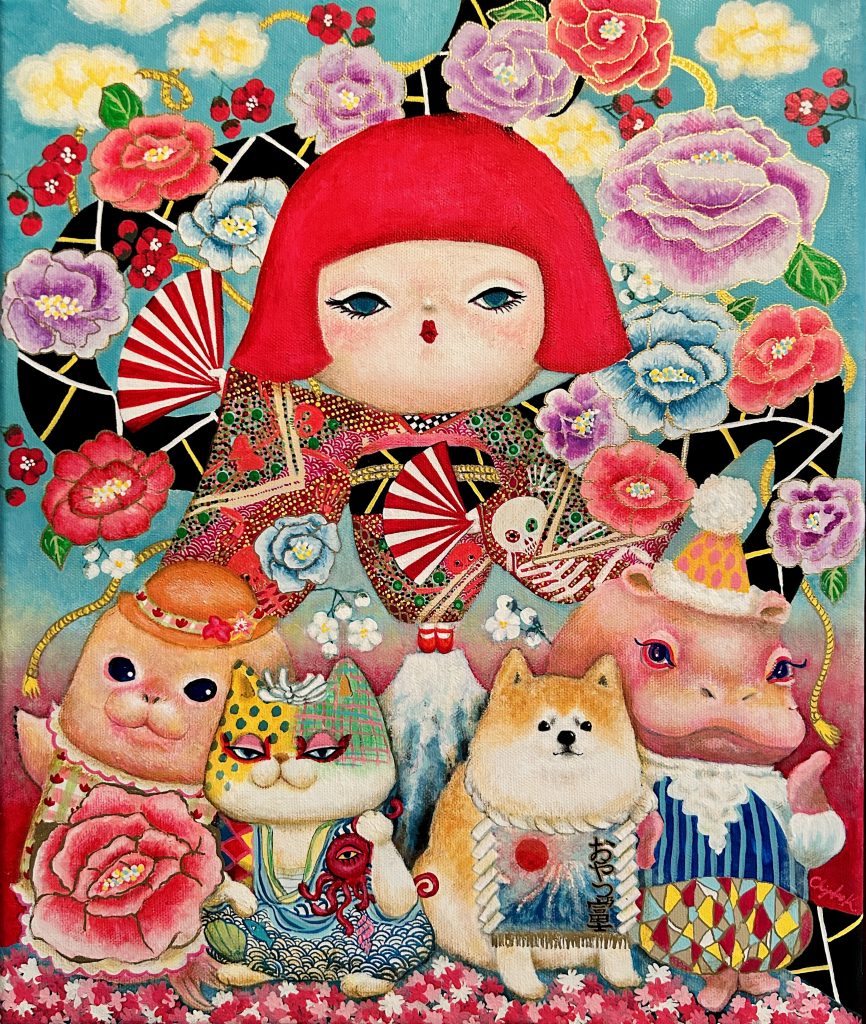
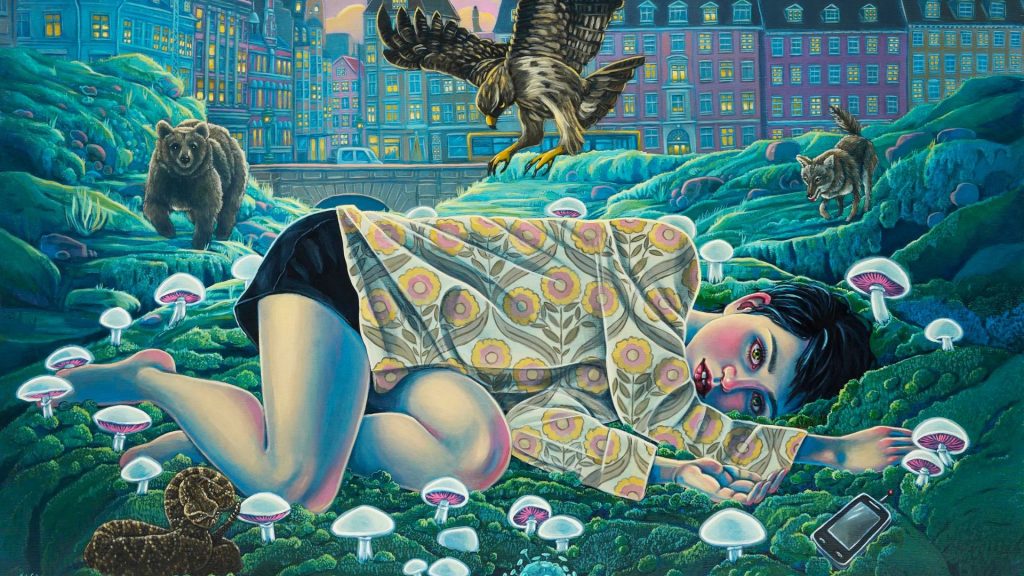
Stephanie Hill is a Canadian artist whose work weaves together mythology, personal experience, and the natural world.
Born in Cornwall, Ontario and now living in Wakefield, Quebec, Stephanie studied at the Ontario College of Art and Design in Toronto, including a formative year at their Florence studio. After a 12-year break from full-time art-making following the birth of her son, she has returned to create her most productive work yet.
Her practice evolved from spontaneous oil paintings to detailed watercolor and oil pastel pieces. She works intuitively, having conversations with the characters she creates, and uses carefully researched historical clothing to place her subjects in different time periods.
Where do you long to live (reality or fantasy)?
Florence Italy
What started you on your journey into art professionally?
It’s been a long, twisty road to get here, but it started with the Ontario College of Art and Design in Toronto, Canada. I did a fine arts diploma with a minor in printmaking, and spent my final, most formative year of college at the school’s off-campus studio in Florence Italy.
I had a ton of art skills at my disposal after finishing school, but I didn’t actually know how to be an artist, so, with no other plan, I moved to Vancouver, Canada and painted as much as I could given the various day jobs I had to keep me going. Then because of a massive artist block and then the birth of my son, there was a lull of almost 12 years where I could only brush up against a serious career as an artist.
As my son has gotten older I have had more and more time (slowly and progressively) to return to full-time art making and to truly be able to work on all aspects of my career. The past 7 years have seen the most evolution and have been the most productive of my life!

How has your art changed and evolved over the years?
I started out in oil paint mostly, painting wet into wet and very quickly. I always started with a carefully worked out composition, but didn’t know what colours or details I would use. I did that for a number of years: very big, very colourful, with underpainting colours coming through. But I started to have trouble with second-guessing myself and obsessively redoing areas before I’d filled in the rest of the painting. I got so frustrated that finally I turned to watercolour with oil pastel as a resist, which was really quick, and I could use the colour in a very saturated way: the result was that I could no longer rework areas and had to always trust my first idea. This new process trained me, through constant practice, to really trust my intuition. I would ask myself, “What colour is next?” and I would have to go with the first one that came to me.
The interesting evolution of using watercolour is that over the last 10 years my work has become more and more about detail, and layering on colours with line work. I still paint in oil, but everything I do now is carefully planned out (still using intuition to guide any decisions) and the minutiae is incredibly important. I finally realized that this is the way I truly love working and now see the whole thing as being meditative.

If your artwork could come to life and interact with you, what kind of conversation would you have with it?
I’d say that my art is continually alive to me and that, as I work on a piece, I am having perpetual conversations with its characters. My characters are similar to dream characters, or a writer’s characters: they tell me the things I need to know about them, to be able to fully realize who and what they are. They might tell me simple things, as in they’d like their dress to be longer, or that they like a particular colour of shoe. They might also talk to me about more profound or complicated things, like how much they love their child or miss their mother. Often these deep, emotional conversations are full of heartbreak and longing, love and joy. The conversation on my part is done once I’ve finished the drawing or painting (unless I keep it for myself – then it keeps going every time we meet in the room it lives in). I always imagine that the conversation continues for whoever adopts the piece.

What is the one statement you could give to your younger self that you would give anything to go back and relay to them at a pivotal moment?
Don’t give up on yourself: making art and being an artist are hard, but you have the patience, resilience and persistence to keep going.
In what ways do you think your personal experiences and emotions shape the way you connect with your work?
They are everything!
I work completely intuitively and throughout any process, I always ask myself: ‘What is it that I want to say?’ My practice is to always trust and follow the answer I get.
I use mythology, archetypes and symbols to express the more complex concepts and very often they stand in for emotional truths. And for imagery, I draw completely from my own life and my own experiences. Both my parents are retired high school teachers who taught English, Art, Theater and History, so my home growing up was filled with literature, art, plays, music and on and on. I come from a big sprawling family and am still close to my parents, siblings, nieces, nephews and cousins: I’m positive that as a result, relationships factor heavily in my work.
I also have grown up on the St Lawrence River, surrounded by miles and miles of life-filled wetlands, and I now live on the Gatineau River in Quebec, so the natural world is a constant source of inspiration to me. In fact, I feel like it is a type of calling, given the climate crisis we face, to bring flora and fauna to viewers in the hope that it helps them connect on a more profound emotional level to the natural world.
We have a thing for oversharing...
New artist interviews, articles, books and more!
What is the most unexpected thing to occur with your work through the years that shifted your perspective in a way you never anticipated?
Twenty-five or so years ago, I was having lunch with an acquaintance (I’ll call her Jane) who was commissioning me to paint a present for her husband (John). My process has always been to meet and discuss commissions, but we don’t talk about what the client wants depicted in the work (I don’t work that way) but instead just talk with them about their life in general. In the case of a gift, I will talk with them about their relationship to the person the painting is to be gifted to. In this particular conversation – we were having lunch at a café – and all through the entire discussion I kept envisioning the most tremendous image of Jane as a bird: her head on a bird body.
I didn’t say anything at the time, but came home and worked on a drawing of the painting’s composition, and included Jane as I had seen her, in bird form. When I showed her the drawing, she was shocked and somewhat speechless. She then told me that years before, she and John had a pair of lovebirds as pets. At a pivotal time, she was having doubts about the relationship and decided to leave John for a former relationship. The day she left, the lovebirds somehow escaped and were never seen again!
This information had a profound effect on me. I had questioned the vision I had of Jane as a bird, but had decided to depict it regardless of doubt. This experience taught me to always trust my inner voice, and I have practiced this approach with every creative project I have since undertaken.

Have you ever imagined your art as a time capsule—what do you think future generations would think of it?
I believe my art is a type of time capsule, but more about the past in relationship with the present, than with the future. Because I see myself through the genetics and relationships with family and ancestors, I feel I am always having conversations with those who came before me, hoping to learn something about who we are now. I use carefully researched clothing to represent different moments in time and clothe my characters in order to place them there.

What advice would you give an artist starting out (young, middle-aged, old – any age) who wants to do it professionally?
Keep drawing and hone your craft! And be prepared to become very resilient. I’ve known a lot of very talented artists in art school who no longer make art because they gave up once they faced rejection. If you keep working, in whatever capacity you can, keep growing your work, and decide not to give up, at the very least you will get better and will have a productive and joyful creative life. Most importantly, if you find a way to make art that you love making, as opposed to making art because it will sell, then your work will eventually blossom and people will come to recognize your spark.
And think outside the box: for example, join collectives and/or seek out artist run galleries (like Poetic Tiger). I belong to an art studio coop, and the relationships and inspiration I have found there have been wildly important to my creative and professional life. There is incredible strength in community!