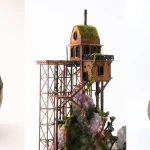
Nestled in the Apennine mountains where Emilia meets Tuscany, artist Gioconda Pieracci creates mixed media works using modeling clays after shifting from her earlier focus on textiles.
Her journey from corporate employment to full-time art began when her company shut down and moved operations abroad. In this conversation, Pieracci shares her recurring dreams of a whitewashed house by the sea, the stranger who told her “This should be your work,” and her realization that she needed to satisfy “the poetic little girl I carry inside me.” She describes becoming “less wealthy now — but far, far happier” after dedicating herself fully to her art.
Where Are You From?
I live in Italy, nestled in the Apennine mountains where Emilia meets Tuscany, in a small village embraced by beech and oak forests.
Where do you long to live (reality or fantasy)?
It may sound strange, but a house and a city often return to me in dreams. The house is wide and whitewashed, bathed in light and steeped in silence.
It is not new—its walls whisper of age, perhaps like an old masseria—but being there fills me with a sense of freshness and profound peace. The city that accompanies it fits seamlessly, as if born from the same breath. It is the color of sand, with narrow alleys that wind and climb, a place carved by time.
Birds live abundantly there—above all, swallows—that dive boldly from the cliffs. The city faces the sea. Its streets are alive with people, yet no cars disturb the quiet rhythm of life. The air is laced with salt and fine sea spray, light as a breath on the skin. Perhaps one day I will find this place I’ve dreamed of for so long, though I have no map to guide me. I only know that when I am there, I belong—and the air is weightless.

What started you on your journey into art professionally?
Art has always been a part of my life — a quiet companion, always present, even when I wasn’t fully listening.
For years, my studies and career followed a different course, as if creativity were something to keep on the margins.
Then one day, I met a woman. A stranger I admired a lot.
She looked at what I was making and said, simply:
“This should be your work.”
And I believed her. Maybe I needed someone to say it aloud — to see in me what I hadn’t yet dared to claim.
It would still be a long time before I could call myself an artist, before I could say those words with confidence.
Self-doubt held me back.
But I began to work, to truly commit.
And from that moment on, I never stopped.
Because deep down, I had always known — even as a child — that this was my path.

How has your art changed and evolved over the years?
My art — and the way I approach it — has changed a great deal over time.
Not only in terms of materials, shifting from a focus on textiles to modeling clays and a more complete mixed media approach,
But most of all in the perspective I bring to the work.
In the past, inspiration often came from the outside.
Now, it rises from within.
If your artwork could come to life and interact with you, what kind of conversation would you have with it?
If my creatures were to awaken, we might find ourselves together deep within one of my forests, between shadows and trees.
I would ask them, perhaps, from what realm they have come— are they the children of dreams?
Whispers lingering from lives long past, or spirits dwelling in a parallel dimension, unseen by most?
Or maybe words would fall away, and in the silent symphony of the woods, we would simply exist — bound by a silent understanding that goes beyond language, as I would like to happen between humans.
I would tell my younger self to be brave, to follow the path that has always called her, to seek no approval—not even from her parents—but to stay true to who she really is.
What is the one statement you could give to your younger self that you would give anything to go back and relay to them at a pivotal moment?
I would tell my younger self to be brave, to follow the path that has always called her, to seek no approval—not even from her parents—but to stay true to who she really is.
Yet there was a time when I lost my way, and it took years of hard work to realize that the only person I needed to satisfy was the poetic little girl I carry inside me.
In what ways do you think your personal experiences and emotions shape the way you connect with your work?
My experiences and emotions deeply shape my work.
I realize that every moment I have lived, every feeling that moves through me, finds its way back into my art — in a color, a shape, a story that quietly emerges.
For example, theatre, which accompanied me for years, and poetry, a lifelong love, have carved their place in my creations— first openly, then more subtly, like a soft undertone that perhaps only I can hear, yet it helps to convey my inner world outward.
I was a shy, introspective child, but deeply in love with books and imagination, with an inner world very rich in images and feelings and all of this has poured itself into my work.
I am far better at filtering what I feel through my art than at telling my story in words.

What is the most unexpected thing to occur with your work through the years that shifted your perspective in a way you never anticipated?
At a certain point, my “regular” job began to fall apart. Not long after, the company I worked for shut down and moved operations abroad.
It was time.
Time to devote myself fully to my art.
Time to finally give myself a chance, to stop silencing the little girl inside me — the one filled with dreams and poems, the one who had waited so long to be heard.
It was also time to stand against the voices that had filled me with fear about the future.
Of course, my life changed. I am less wealthy now — but far, far happier.
Have you ever imagined your art as a time capsule—what do you think future generations would think of it?
I hope that they would look closely—not just at what it is, but at what it holds.
Each line, each form was made slowly, deliberately, by human hands and a dreaming heart.
And maybe, just maybe, that person will feel called to slow down, to create something true, and to trust the quiet language of the hands.

What advice would you give an artist starting out (young, middle-aged, old – any age) who wants to do it professionally?
If I could offer one piece of advice to an artist just starting out and dreaming of turning their art into a profession, it would be this:
Stay rooted in your truth.
Look to the paths of other artists for inspiration, but never compare yourself to them.
You are in your own place, your own time, your own dimension.
Be consistent.
Treat your art with seriousness — but never stop playing.
Maybe your art isn’t your main source of income, at least not yet, but it is, and must always remain, a source of joy.
And that part is up to you.