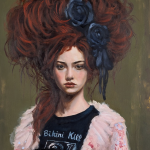
After years of chasing the wrong styles and subjects, Paine Proffitt finally gave himself permission to paint what he actually wanted.
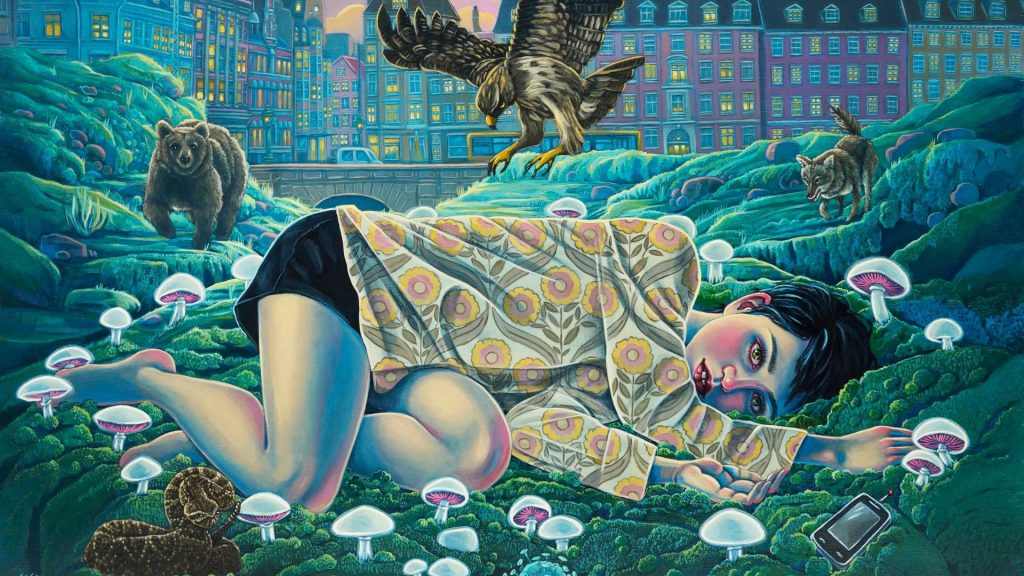
Nine years ago, he walked away from a futurism style he’d nearly perfected to embrace the whimsical, gothic, and deeply personal work that now defines him. Based in Stoke-On-Trent, England, Proffitt creates pop-surrealist paintings populated by cats in dresses, silent gothic women, and his recurring character Goth Bunny—all of them reflecting the emotional landscapes he needed to explore.
Where Are You From?
I’m an American living in England. After moving all over the world as a child, my family settled in the Philadelphia area when I was a teenager, which is where I consider my childhood home. But I’ve been living in Stoke-On-Trent in England for almost 25 years now, which I consider my real “home”.
Where do you long to live (reality or fantasy)?
I’m happy where I am but I spent a year at art school in Brighton (England) and I loved it there. I would love to live near the seafront in Brighton if I could. A part of me wouldn’t mind some time in Aberdeen, Scotland as well.

What started you on your journey into art professionally?
I’ve always loved art and it’s always been something I’ve wanted to do with my life. I came out of art school as an illustrator and worked in the illustration world for a while before leaving it to work on my own artwork. Illustration was a start but I soon realized that it wasn’t the right path for me at the time.
How has your art changed and evolved over the years?
My work has change so much and so completely and so many times over the years. Sometimes I think back to some of the artwork and styles I’ve done in the past and I don’t recognize that person or artist at all … entire years of work that I literally can’t remember doing those paintings. The biggest and most significant change came about 9 years ago … I was finally getting to a level of quality that I was happy with in a Futurism style that I used to work in, which I was starting to get recognized for, but I got frustrated that I couldn’t do the artwork I wanted to do or say the things I wanted to say through this style.
And the paintings took too long and I was miserable doing the pieces. I knew I had to change everything and I roughly knew the direction I wanted to go, so I turned my back on that old style and started over again from the start. It was a difficult and scary step to take but I knew it had to be done. So I changed my work from a Futurism style that mostly focused on sports to a more whimsical, narrative, often gothic or surreal style…
I guess pop-surrealism would be the closest label. But with that change, I was finally doing the paintings that I wanted to do and I’ve felt so much happier doing my artwork since. And since then I’ve felt like my work has been evolving naturally but still on the same path.

If your artwork could come to life and interact with you, what kind of conversation would you have with it?
Hmmm. It really depends on which of my paintings comes to life and starts talking. One of the issues I face with my work is that I try to paint what I feel or what interests me … and I’m a bit all over the map with that. It’s actually a problem because each subject I paint might interest one group of people but completely turn away all the others. One day I’m painting football (soccer), the next day I’m painting goth pieces, the next day I’m painting about the pottery industry of my hometown, the next it’s looking at music and albums I love, then it’s 1920s flappers.
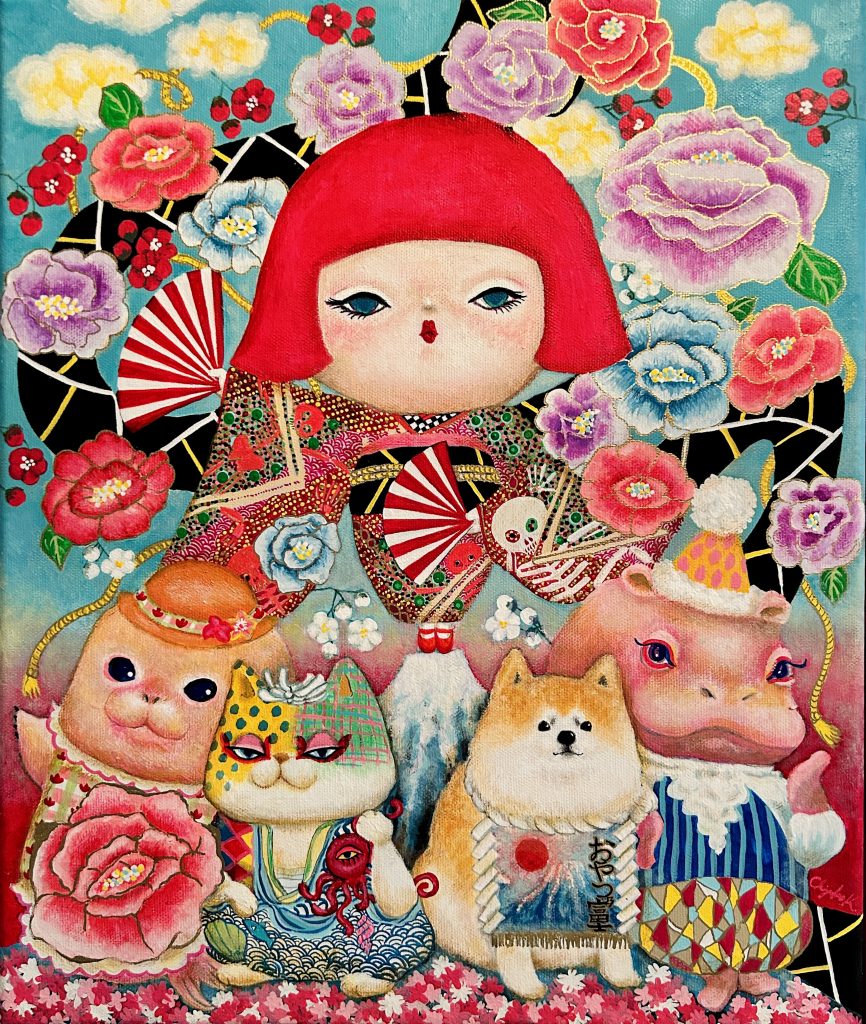
And then sometimes I just like painting cats in dresses. All those are very different conversations. Each subject tells a different story and means something special and personal to me. Mostly they’re about an emotional place; memories; nostalgia and past; beauty and inspiration; experience and feelings; anger and sadness; etc. but they come out in these subjects.
It would be nice to maybe sit with a cup of tea and have a conversation with one of the cats or bunnies in my paintings. I think they’d be poetic, whimsical and odd little conversations, like something out of Alice In Wonderland… but hopefully there’s something lovely in that.
A conversation with one of the gothic women in my pieces would probably be awkward and unsettling… they would just stare silent holes through me… and then I’d just blurt out an apology for nothing in particular and start crying.
And nobody wants to have a conversation with a soccer player… believe me.
Oh, I would like to have a conversation and a cup of tea with Goth Bunny… she’s one of my reoccurring characters and I think she’d be a delightful conversationalist. We’d talk about music, art, dreams, films, feelings, whimsical stuff, and all sorts. I think we’d laugh a bit too. She’d be a little friend.

What is the one statement you could give to your younger self that you would give anything to go back and relay to them at a pivotal moment?
I’d go back to the beginning and tell myself to just do the artwork that you want to do from the start. Follow your instincts, experiment and have fun – don’t worry about mistakes or what anyone else thinks – and maybe most importantly, do the artwork that interests you. Paint the subjects that you want and are interested in, and paint them in a style that you want. Even if it isn’t popular or to a majority’s taste, you’ll find the right level and the right people will become your community. I was ridiculously late in even realizing that I could paint what I wanted or what interests me.
I’m still stunned at how long it took me to realize that. Saying all that, I do think that maybe I had to have years and years of frustrations and wrong turns in order to get to this point and to have this realization, to know what I’m not and not happy with, and what’s important to me in my artwork. If I went back and told my younger self all this, he wouldn’t have really understood it at the time. Sometimes maturing naturally as an artist and as a person is the only way.


In what ways do you think your personal experiences and emotions shape the way you connect with your work?
Most of my work feels like it comes from me now and in one way or another the paintings are personal. Almost all of it is emotionally driven and my thoughts, feelings, interests, doubts, opinions, loves, hates, and past are put into the artwork. There are different artists with different priorities or aims, but for me everything in my work is connected to my personal experiences and emotions in my paintings.
What is the most unexpected thing to occur with your work through the years that shifted your perspective in a way you never anticipated?
At times, the artwork has been a way of dealing with personal or difficult times in my life. It’s helped me process hardships, heartbreaks, loss and pain. And has been pivotal in helping me deal with things, heal and grow. These paintings can help me get through trauma and deal with things directly and subconsciously, and give me time to think about and process my thoughts and feelings. Sometimes I can come out of these times a little different as a person and as an artist… hopefully better, hopefully wiser. The artwork has been a big and unexpected part of that.
We have a thing for oversharing...
New artist interviews, articles, books and more!
Have you ever imagined your art as a time capsule—what do you think future generations would think of it?
I think there is an element capturing a certain time in my work… maybe something in the style of the artwork. While I’m influenced by a lot of vintage and nostalgic art and photographs, especially from the 1920s and 30s, I feel like there’s a visual influence of the 1990s in my work. I don’t know. But people in the future would probably be able to look at the work and place it at a certain time. And some of my work, especially with a recent music series, makes direct reference to albums that come from a particular era (from the late 80s to early 2000s), so they act as a timestamp just by subject matter. I hope my work is a little more timeless and can stand on its own in the future, but there are definite references and influences that can be recognized from the past.
While I think future generations would find cultural references to my work that speaks of a certain era, I think they might also find other elements of politics, social commentary, humour and opinion that could be an interesting insight of our time. But I also hope there are timeless themes that run through my work that they’d be able to understand and feel directly… heart, emotion, loss, love, death and the human condition. I hope people might connect to the artwork well into the future.

What advice would you give an artist starting out (young, middle-aged, old – any age) who wants to do it professionally?
The biggest bit of advice is to be honest and do the work that’s true to yourself. Do the artwork that you want to do, focus on the subject matter that you’re interested in or that’s in your heart, and express yourself the way you want to.
I’d also say work hard and work on your art all the time that you can. It might take years before you start doing artwork that you like or feel like you’re getting anywhere, but keep at it. Keep going and don’t stop.