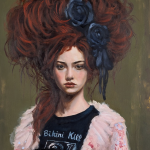
Jel Ena grew up surrounded by art. Raised in Belgrade, Serbia by a painter father and painter mother, she came to the work not as a choice but as an inheritance, and eventually, an inevitability.
After relocating to Los Angeles in the ’90s, her palette brightened and her practice evolved in directions she never fully planned. Today she is best known for her expressive, character-driven cat paintings, made under the Instagram handle Mister Jellyfish, where a devoted community has grown around her work. We sat down with her to talk about change, connection, and what it means to follow the work wherever it leads.
Where Are You From?
I’m originally from Belgrade, Serbia, and I’ve lived in Los Angeles since the ’90s. I was raised by a painter, so the work ethic came from home, but everything else evolved over time. Moving to LA was a shock. The scale, the light, the constant sun. Coming from a much grayer, heavier atmosphere, the color here felt almost exaggerated. It changed the way I paint. My palette became brighter, more saturated, more direct, like the city itself.
Where do you long to live (reality or fantasy)?
I don’t really have a dream location. I’m more interested in how a place feels than where it is. I want to be able to work, exist in peace, be close to my family, and live with as many cats as I can reasonably justify. If Los Angeles allows that, then I’m fine staying.

What started you on your journey into art professionally?
I grew up in a household of painters. My father was not only a painter but also an illustrator for a major newspaper in Belgrade and a professor at the Academy of Applied Arts. My mother was an internationally exhibited painter, with her work in collections beyond our country. So I was surrounded by art from the very beginning.
Interestingly, my parents encouraged me to pursue a more stable path. They knew how demanding and often unrewarding an artistic life can be. They wanted me to have a broader education and explore other directions. And I did. I followed that path, completed the studies they hoped I would, but I never stopped drawing and painting on the side.
That need to create never left. At some point, it stopped being a question and simply became the only direction that made sense.

You moved away from figurative into furry animals a few years ago and started using the IG handle Mister Jellyfish. Although you still paint figurative works from time to time, your main focus is cats. What prompted this change?
I didn’t plan it as a shift. It happened gradually. After years of figurative painting, I began focusing more on cats and realized they gave me a different kind of freedom. I could push personality, emotion, and subtle narrative in a way that felt more instinctive.
There was also a strong response from people, which I couldn’t ignore. But more than that, something shifted in me. When I paint cats, I feel completely free. There’s no restraint, no sense of being judged. It feels direct, almost instinctive, like I’m working from a place I don’t question.
I’m drawn to them in a way I can’t fully explain. Over time, they stopped being just a subject and became part of my everyday life, something constant. I spend most of my days painting them, and I don’t get tired of it. If anything, I feel more connected each time. Whether it’s my own work or a commission, that connection is always there. At this point, I can’t really imagine my life without them.

When you changed and focused mostly on this newer work, did you find that your supporter base followed you? Did you get any pushback?
Yes, the change was quite drastic, and I did feel it. I lost some collectors and followers along the way. People who were connected to my figurative work didn’t always follow me into this new direction. Of course, some did, and I’m very grateful for that.
But at the same time, something else happened. Painting these small, furry subjects brought a completely new audience into my life. And I have to say, cat people are unlike any other. There’s a warmth and generosity there that I didn’t expect.
The support I receive now, especially through my Mister Jellyfish Instagram, which is dedicated almost entirely to my cats, is incredibly strong and consistent. So while I did lose part of my original audience, I gained something that feels more connected, more engaged, and honestly, more aligned with who I am now. I wouldn’t trade that.

What do you love most about painting cats?
What I love most is the freedom. When I paint cats, I don’t feel restricted by expectations in the same way. I can push expression, exaggerate character, and focus on small details like eyes or fur in a way that feels completely natural to me.
But it’s also more than that. There’s something about them that I’m deeply drawn to. Their presence, their personalities, the way they can feel both familiar and mysterious at the same time. I never feel like I’m repeating myself, even though I paint them every day.
There’s also a kind of quiet connection that happens while I’m working. It doesn’t really matter if it’s my own piece or a commission, I always feel like I’m spending time with them in a very real way. That’s something I don’t question anymore. It’s just part of how I work.

What is your favorite cat you painted?
All of them, honestly. Each one feels like its own little encounter. I spend so much time with every painting that they all stay with me in different ways, so choosing one would feel a bit unfair.
You do a handful of wonderful commissions each year. What kind of feeling does it bring to paint a beloved furry friend for someone?
It’s a very different kind of responsibility. When I’m painting someone’s cat, I’m not just painting an image, I’m holding something that matters deeply to them.
There’s always a moment where it shifts from being a painting to becoming that specific animal, their presence, their personality. I take that seriously. I want them to feel seen, recognized.
Many of the commissions are of pets that have passed, and those carry a different weight. I’m aware that I’m working with memory, with something that’s still very alive for the person who loved them. In a way, I’m trying to bring them back, not literally, but enough that their presence can be felt again.
When it works, it’s incredibly meaningful. It feels like I’ve helped preserve something that isn’t gone, just changed. That’s something I don’t take lightly.

We know you get asked about your figurative work quite often. For people wanting to know, will you ever be shifting back to primarily figurative works?
I think I’ll always do both. Right now, cats have taken center stage, and that feels natural to me. I don’t have a timeline for whether that will shift, and honestly, I’m not in a hurry for it to.
At the same time, figurative work is still an important part of my practice. I need that outlet. It allows me to explore something different, and often the two overlap in my work anyway.
So it’s not really one replacing the other. It’s more about where the focus naturally falls at a given time.
What is the one statement you could give to your younger self that you would give anything to go back and relay to them at a pivotal moment?
I’m not a big fan of going back and rewriting things. Most of what mattered came from figuring it out the hard way. The mistakes, the doubts, all of it shaped how I work and how I see things now.
If I had to say something, it would be simple. Trust what keeps pulling you back to the work. Even when it doesn’t make sense yet.
In what ways do you think your personal experiences and emotions shape the way you connect with your work?
I don’t really separate personal experience from the work. It’s not about specific events as much as it is about everything accumulating over time and shaping how I see.
Moving from Belgrade to Los Angeles was probably the most significant shift. The atmosphere, the light, the scale, even the pace of life are completely different, and that changed the way I respond visually and emotionally. It shows up in my work through color, through intensity, through how I approach mood and presence.
I don’t set out to translate experiences directly, but they’re always there. They come through in how I see, what I focus on, and how I try to capture a feeling rather than just an image.
What is the most unexpected thing to occur with your work through the years that shifted your perspective in a way you never anticipated?
I think the most unexpected thing was how my work shifted toward cats, and how strongly people connected to it. It wasn’t planned at all. It just started happening, and little by little it took over.
What really surprised me was the kind of people it brought into my life. The connection is very real. People are open, emotional, and deeply attached to these animals, and that comes through in how they respond to the work.
I didn’t expect that. I didn’t expect that painting cats would change not just what I do, but also who I connect with. It shifted my perspective in a way I couldn’t have predicted.
We have a thing for oversharing...
New artist interviews, articles, books and more!

What advice would you give an artist starting out (any age) who wants to do it professionally?
I tend to avoid giving advice because there isn’t one clear path. It’s a difficult and often unpredictable profession.
The only thing I can say is that consistency matters. If you feel the need to create, keep showing up for it. Pay attention to what you’re drawn to and don’t ignore it. That pull is usually more reliable than any outside guidance. Over time, that builds something real, both in the work and in how you relate to it.