Where Are You From?
Toronto, Ontario, Canada
Where do you long to live (reality or fantasy)?
By a lake in a small town
What started you on your journey into art professionally?
Art has always felt like a natural path for me, and I’ve identified as an artist since I was little. I always imagined I’d grow up to be one. I also love supporting other artists, which led me to work in arts administration and organizing art events. It was something I really enjoyed, and was a fun adventure.
But eventually, I realized I wasn’t making my own work anymore. I was surrounded by creativity but no longer actively creating. That was a wake-up call.
About six years ago, I committed fully to my practice. I started applying to every show and gallery I could and gradually built the career I have now. Things have been steadily growing, and I’m grateful to be gaining momentum, showing with galleries I love, and exhibiting alongside artists I admire. I still enjoy working part-time in arts administration, but I’m very intentional about protecting time for my own practice and prioritizing my goals for my art.

How has your art changed and evolved over the years?
Over the years, my work has become a lot more focused. I had to unlearn the idea that being a “good” artist meant being able to paint anything and everything. For a long time, I felt like I had to prove I had range in order to be taken seriously. But the turning point came when I stopped worrying about that and just made the work I actually loved making. Once I leaned into what felt natural and exciting, I found my distinct style and began establishing the elements I love to use as my parameters to push and pull against.
It’s funny, creating rules around my style has actually increased my inspiration. It feels like there are endless combinations within those guiding principals. I’ve also stuck with a limited color palette, and that challenge has pushes me to get more creative with how I use it. Not trying to include every color and concept brings a sense of clarity to my ideas. And when I feel like bringing in new elements or taking a different direction – guess what? Rules are made to be broken too.
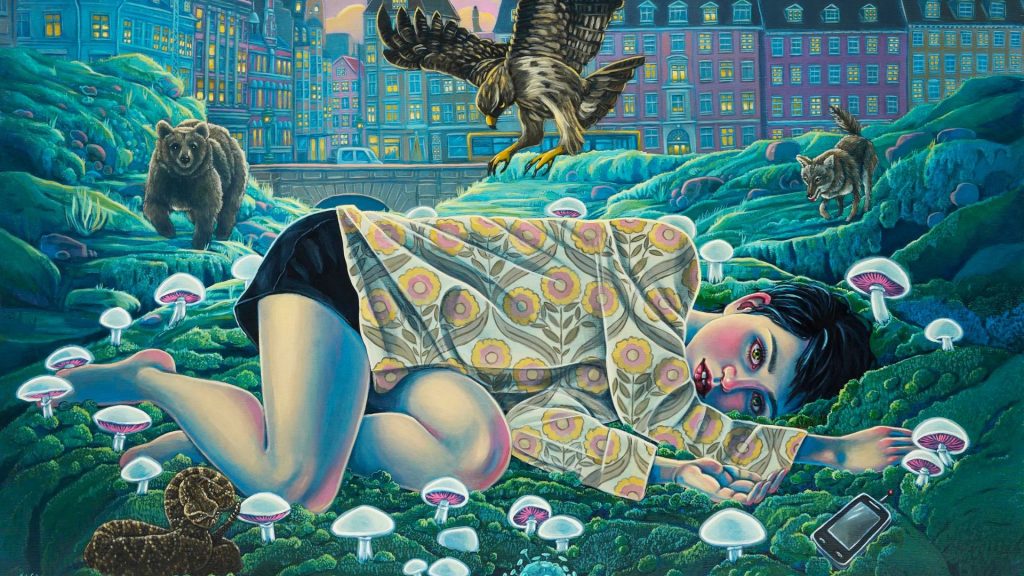
Figuring out my actual painting process has been both the most frustrating and the most rewarding part of creating my work. I work with a mix of materials: oil paint for soft, detailed figures, and acrylic, spray paint, airbrush, and stencils for bold, flat shapes and patterns. I’m a total process nerd and when you finally match the process to how you visualize the piece in your head, it’s a total high, and that’s a big part of what pushes me to keep painting.


If your artwork could come to life and interact with you, what kind of conversation would you have with it?
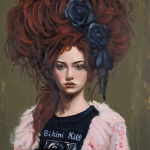
I paint a lot of women with resting bitch face. That’s only kind of a joke. My characters tend to stare you down and make you sit with the discomfort of being truly seen. I want them to act as a touchpoint for recognizing yourself. So I think any conversation with them would be a little intense. It would be the kind where you have to be honest with yourself. Not in a negative way, but more like how your closest friend who knows you better than you know yourself would talk to you. The one who really knows you, loves you, and reminds you to trust who you are and lean into it fully with strength and vulnerability. She would probably tell you that you got this, and not to take any shit.
What is the one statement you could give to your younger self that you would give anything to go back and relay to them at a pivotal moment?
Don’t wait to put yourself out there until you think you’re “good enough.” Your skill and your work will always be evolving. There’s no such thing as being completely “ready.”

What is the most unexpected thing to occur with your work through the years that shifted your perspective in a way you never anticipated?
One of the most unexpected things that has happened in my life and my practice came when I was diagnosed with rheumatoid arthritis, an autoimmune disease that affects my joints and energy levels. As a painter, it’s a scary thing. There were (and still sometimes are) days I can’t even hold a brush.
For a long time, things were really bad. I could barely paint. It came to the point of quit or adapt, so I adapted. On days when painting wasn’t possible, I focused on other parts of my practice, like developing concepts, applying to shows, or documenting finished work. And when I did have energy and mobility, I tried to make the most of it in the studio.
What surprised me most was how that period shifted my mindset. Before my diagnosis, I often wrestled with what I affectionately call “easel anxiety”. But when I could barely paint, I didn’t have time to spiral or overthink. I had to use the energy I had, when I had it.
While I’m in a much more manageable place now thanks to treatment, rheumatoid arthritis is something I live with every day. But going through that stretch of limited ability continues to shape how I work and how I care for myself as an artist. It’s made me more present, more grateful, and more committed to my practice.
We have a thing for oversharing...
New artist interviews, articles, books and more!

What advice would you give an artist starting out (young or older) who wants to do it professionally?
You don’t need a fancy studio, but you should have a space that’s just for your art. Even if it’s just a desk or a corner of a room, having a dedicated spot helps in two big ways.
First, it signals to yourself that this matters and is worth taking seriously, you’re literally and figuratively making space for it in your life. Second, it reduces the friction of actually getting started. It can be hard to push past anxiety or resistance, especially when you’re working through something vulnerable or new. But if you have a space that’s ready for you, it becomes a lot easier to show up for yourself and your practice.
That, and listen to the Ira Glass talk about the “Taste Gap” where he talks about the painful period where you are making work that is not as good as your taste, and how the only way to close that gap is to just keep making the work. That had a big impact on me and is something I remember.