We sat down with San Francisco-based artist Sandra Yagi to discuss her journey from corporate finance to full-time artist, and how contemplating mortality transformed her work from traditional landscapes into richly symbolic paintings populated by expressive skeletons, endangered creatures, and the transient beauty of our existence.
Where Are You From?
San Francisco, CA. (Grew up in Denver, CO)
Where do you long to live (reality or fantasy)?
Here in San Francisco. My fantasy when I was a teenager in Denver was to have an artist’s loft in California.
What started you on your journey into art professionally?
I always loved to draw and paint, starting when I was a kid. My desire to pursue art was side-lined after my father pressured me to pursue a practical career. Thus, I obtained my masters degree in business, and a career in finance. However, I still longed to draw. After graduation and getting a corporate position, I met an older woman named Renee in Los Angeles while I was sketching at a coffee house.
She advised me to not delay my art practice. She had waited until she retired, but found that she didn’t have the energy needed to work on large scale sculpture. I took her advice, enrolled in continuing education art classes, and took up watercolor painting when I was in my early 30s. I worked as a part time artist while keeping my day job at a major bank. My employer transferred me to San Francisco, and then I rented a work only studio here and began exhibiting.
I painted during all of my free time, and finally left my day job in 2008 to be a full time artist. I have never regretted that decision and I am forever grateful to Renee for her advice.

How has your art changed and evolved over the years?
I started out painting very traditional subjects, such as landscapes and still lifes. But after a time I became bored and I started to wonder if I had anything deeper to say with my art. After some life changing experiences, I started looking more inwards, and asking bigger questions. That’s when my art shifted to less marketable but more interesting subject matter.
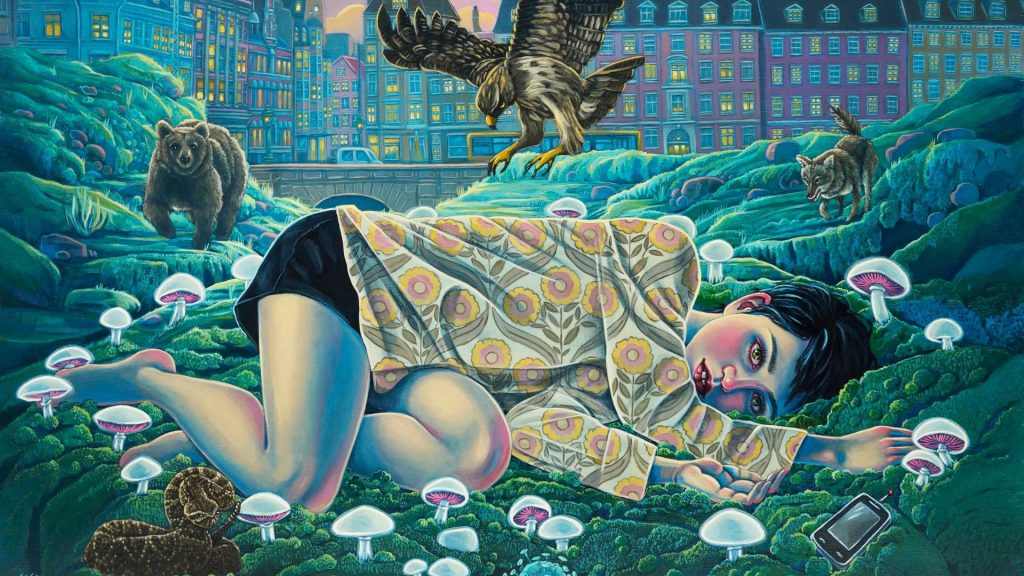
While I still look at reality as a starting point, the worlds that I paint do not really exist. I began exploring the theme of mortality with my work. I marvel at our existence, and I think it’s made all the more bittersweet because I know that nothing lasts forever, and that mortality awaits all of us. It’s not all doom and gloom; I believe that endings lead to new beginnings.
I used to dread the thought of death, but then I realized I wasn’t upset before I was born. So I’m not afraid of it anymore. I think it makes me treasure this existence and value even small things, like beautiful clouds.


If your artwork could come to life and interact with you, what kind of conversation would you have with it?
I would ask the skeletal characters what happens on the other side. Is there another dimension in our universe?
What is the one statement you could give to your younger self that you would give anything to go back and relay to them at a pivotal moment?
I would tell my younger self to live life to the fullest, not to get discouraged, and to keep drawing and painting.
In what ways do you think your personal experiences and emotions shape the way you connect with your work?
When one is young, you don’t think about life as being finite. The idea of being 70 years old seems foreign. But as you age, you begin to experience losses, of friends, family and your own youth. I was by a dear friend’s bedside at the moment he transitioned from this life and passed away. It was a powerful moment, and it taught me that nothing is permanent. Thus I have much more gratitude for being alive and experiencing this existence. That’s why I often include skeletons in my work – I love the beautiful form of the skeleton, and I love the symbolism it carries. It’s a reminder to me that everything is transient.

What is the most unexpected thing to occur with your work through the years that shifted your perspective in a way you never anticipated?
The most amazing thing I discovered was how expressive a human skeleton can be. By just tilting the head and posing the skeletal frame in a certain way, it can convey powerful emotions such as joy or longing. Our emotions are not simply conveyed in our face -it’s expressed deeply at the muscular and skeletal level.

Do you have any superstitions or quirky habits when you’re creating?
I get real grumpy if someone interrupts me while I’m working
What advice would you give an artist starting out (young, middle-aged, old – any age) who wants to do it professionally?
I think being an artist is so rewarding, but it is also a difficult and uncertain vocation. I would recommend that a budding young artist also have another way to make money- another skill or occupation that you can fall back to during hard times when your art isn’t selling or the grants aren’t being awarded. At the same time, don’t stop making your art and don’t give up your vision. Even if you work 8 hours, try to make art for a short period or later in the week on your day off. Eventually your perseverance will be rewarded.
Have you ever imagined your art as a time capsule—what do you think future generations would think of it?
They might perceive that my work, as well as many other artists today, was addressing concerns about the environment at a time when humanity’s destruction of the natural world was at its peak. Much of my work portrays nature, and I hope that in the future, viewers won’t say, gee, I wish there were still sunset moths, elephants and rainbow boa snakes in the world. I love nature, and by including beautiful insects, birds and fish in my paintings, I hope that current and future generations will be inspired to protect the environment.

We have a thing for oversharing...
New artist interviews, articles, books and more!
What are the mediums that you love to use the most and why? Any favorite brands or tools?
I love watercolor, oil paints, ink drawing with fountain pen, and just plain old pencil drawing. But I think oil painting is. my favorite just because of the richness of the color. Also it’s relatively forgiving, compared to ink and watercolor. Favorite brands of oil paint: Gamblin, Windsor Newton and Rembrandt. Favorite tools: Da Vinci synthetic Nova brushes, and Trekell brushes