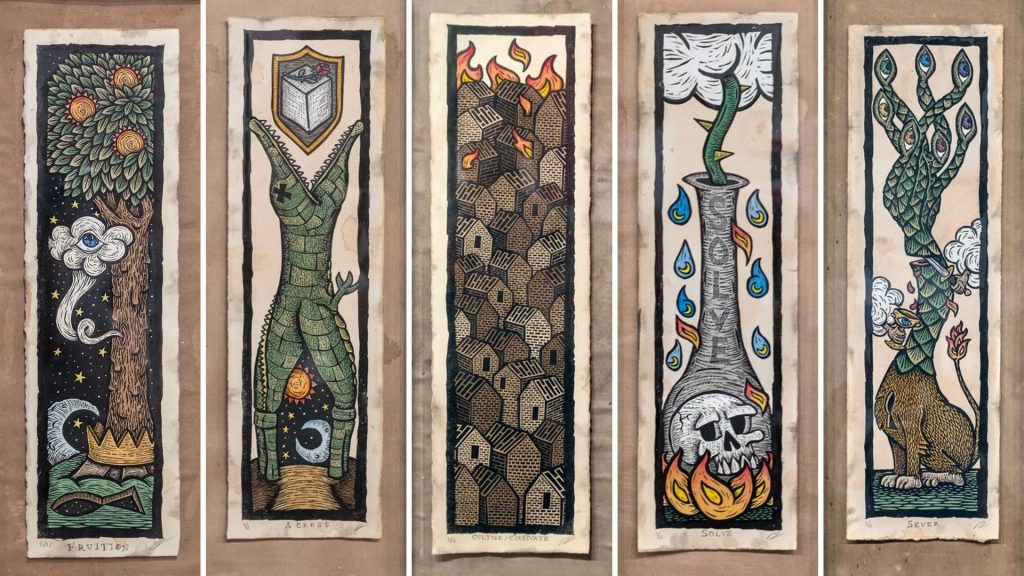
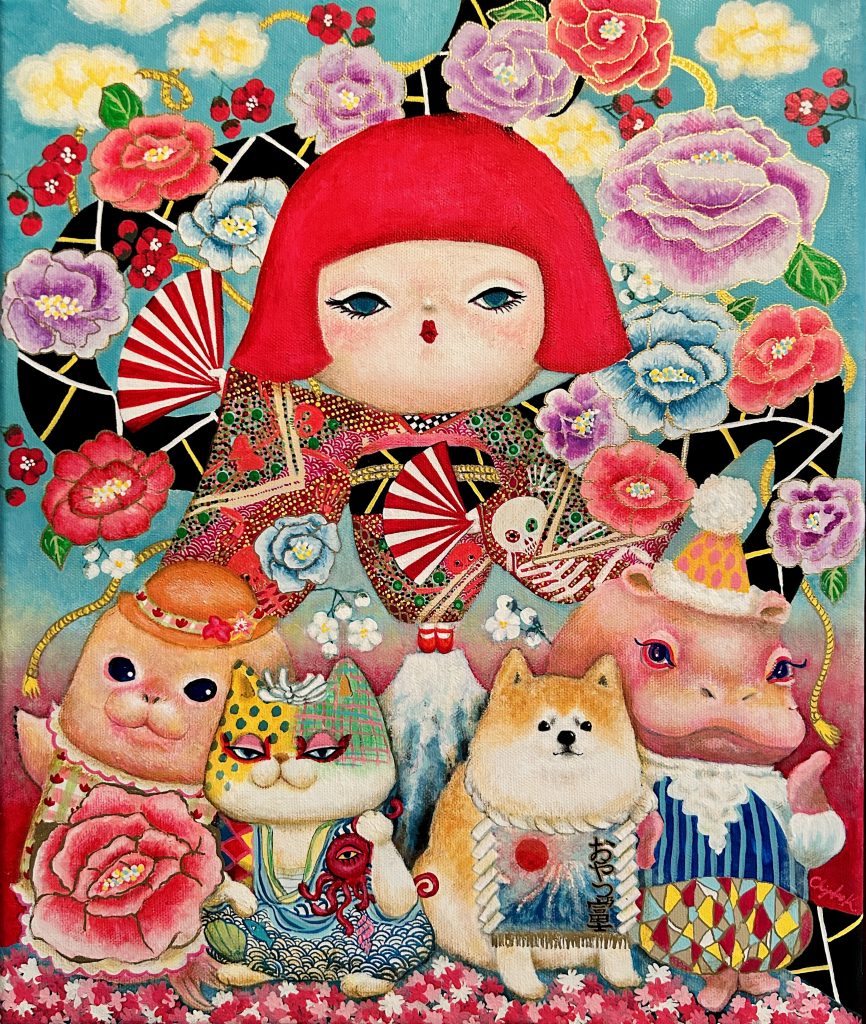
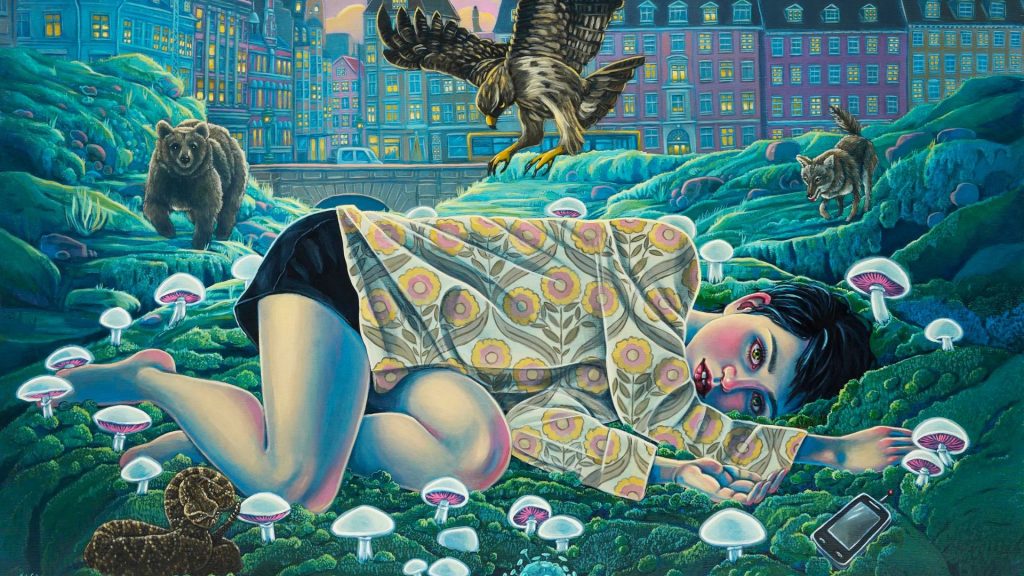
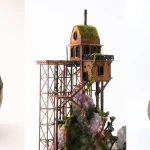
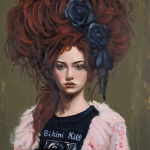
With influences spanning Celtic folklore, Der Blaue Reiter, and illustrators like Trina Schart Hyman, her work exists outside of time—magical, metaphysical creations born from whispered messages beyond the everyday world.
Where Are You From?
While I was born and raised in York, Pennsylvania, I now live and create in Weirton, West Virginia, which is located in the slender swath of land between Pennsylvania and the Ohio River.
Where do you long to live (reality or fantasy)?
I grew up on Celtic folklore and a great deal of British literature, and perhaps because of this, I think I would feel most at home in a stone cottage on a heath somewhere not terribly far from the sea. My cottage would have a little scrubby garden outside, a fireplace inside, a studio (of course!), several dogs, crystals, plants, many books, lots of tea, and plenty of Irish whiskey.
What started you on your journey into art professionally?
There has never been a time when I haven’t been creating. I remember drawing princesses with Rapunzel-length hair and conical hats in blue ballpoint pen on little pads of paper in my father’s office when I was very young. By the early 1980s, my mother got me a subscription to Cricket Magazine, whose art director at the time was Trina Schart Hyman.
Her work and that of illustrator Mercer Mayer had a great impact on my concept of illustrated beauty, both in terms of subject and technique. As I grew up, I never strayed far from art and majored in art history in college. I also spent a year on a fellowship in Munich, Germany, in the late 1990s. There, I studied the work of Der Blaue Reiter (particularly the work of Franz Marc) and worked as an intern and correspondence translator at the Neue Pinakothek, a museum with an amazing Art Nouveau and Impressionist collection.
Fast forward to 2012, when I decided it was time to sit down and really focus on finding my own specific creative voice. It’s been a pretty exciting journey.

How has your art changed and evolved over the years?
I’ve had a longstanding creative relationship with Bic ballpoint pens, and this was the principal way that I explored ideas when I began creating again in 2012. Using only Bic pens, I began the “Women in Water” series, which was soon followed by the “Men at Sea” series, wherein a figure–either historically famous or completely imagined–was in water up to his or her chest. I even drew the literary character Moll Flanders, but the work featured not the bust of Moll but instead her heavily embroidered shoes projecting above the water line.
Slowly, I began to add things like gold leaf, then I extended the drawing onto the mat, and finally, I began to make 3D drawings. In these 3D works, I would lift the mat with foam core so I could insert drawings that projected from the background. In 2016, I took a basic metalsmithing class and learned how to set stones.
This made me long to work in color. I realized I could potentially create pieces that had the quality of Medieval reliquaries (another of my fascinations).
So I moved to a more sculptural approach that involved painted clock cases and other little boxes onto which I would apply paper clay that, once dried, could be drawn on with an ever-sharp pencil or painted with acrylic. Every project leads to new discoveries that I can explore in the works that follow. It’s very exciting!
If your artwork could come to life and interact with you, what kind of conversation would you have with it?
I hope my artwork would pull Oracle cards with me and then tell me what’s going on outside my realm of sensory perception, since I think that’s where some of these ideas come from. These little whispered messages from beyond the everyday world are something I feel I’ve been lucky enough to capture and turn into the tangible. If I could interact with them, I would love to know more about where they’ve come from.
What is the one statement you could give to your younger self that you would give anything to go back and relay to them at a pivotal moment?
Everything you’re going through is nourishing the future you, so trust this process of becoming.

What is the most unexpected thing to occur with your work through the years that shifted your perspective in a way you never anticipated?
I think that I’ve learned to trust myself in the creative process more, and this is unexpected and wonderful. As a younger artist, I felt absolutely defeated if a work was moving in a direction I didn’t like. (And that definitely still happens. I have works standing in the corner of my studio because I’m not happy with them, and they need a timeout.) But within the last few years, I’ve found that if I keep consistently working on a piece and nudging or redoing the parts I’m not happy with, I can move things in a productive direction. In fact, there are some works that I get into a downright wrestling match with.
At 5 pm, I go upstairs to make dinner, and I’m still cheesed, thinking I’ve spun my wheels all day. But these end up becoming some of my favorite works. And it’s largely because they’ve pushed me beyond my creative comfort zone; in the process, I’ve skill-built or found a new creative path to pursue.

Have you ever imagined your art as a time capsule—what do you think future generations would think of it?
Oooo…I really hope that people who encounter my work in the future will recognize my joy and wonder. I don’t have any time-related touchstones in my works–meaning, no contemporary figures or social or political commentary–so it may make the works feel (I hope) outside time, maybe even a little magical, and an escape from the everyday. Someone told me that my work has a very metaphysical quality, so I hope that’s a perception that continues through time.
What advice would you give an artist starting out (young, middle-aged, old – any age) who wants to do it professionally?
My biggest advice is to simply start. If you’re working another job full time or even part time, if you’ve got family responsibilities, (and gah! there’s always laundry and dishes to do), carve out even just a little time every day.
It could be before bed or in the morning before anyone gets up. But start. And while it’s counterproductive to pressure yourself (because who needs more pressure in life, right?), set a routine and make it a daily practice, so that you are able to consistently work and make progress on pieces until you have a collection that’s ready to show. It won’t happen right away, but if you’re consistently active, it will come together.
Even on days when I’m feeling stressed or unproductive, I go into the studio and once I get working–even on something like a quick, warm-up drawing or collage–I’m able to move forward on the larger pieces I want to finish. It’s all about starting and being consistently active. From this consistency, opportunities blossom.
We have a thing for oversharing...
New artist interviews, articles, books and more!