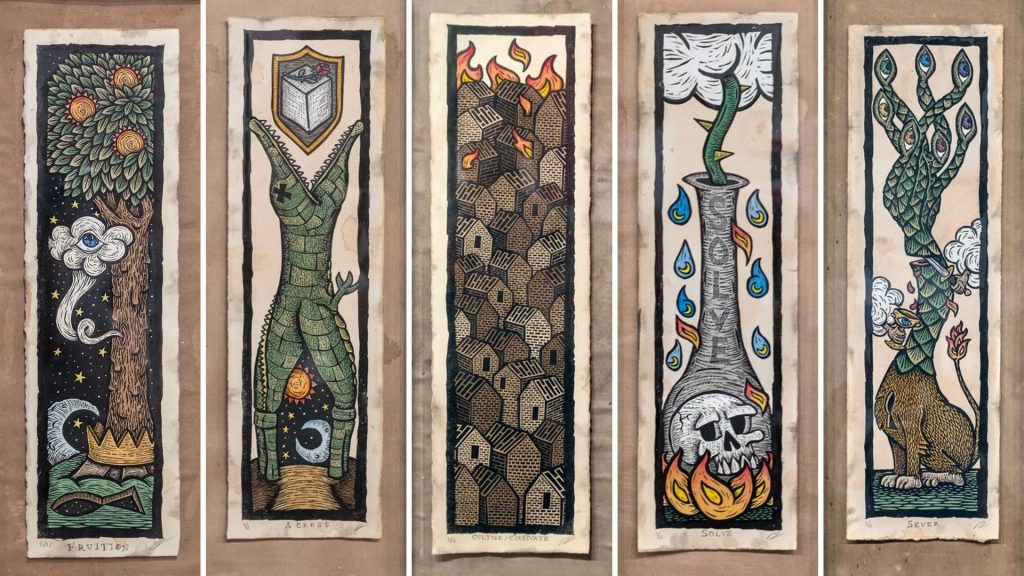
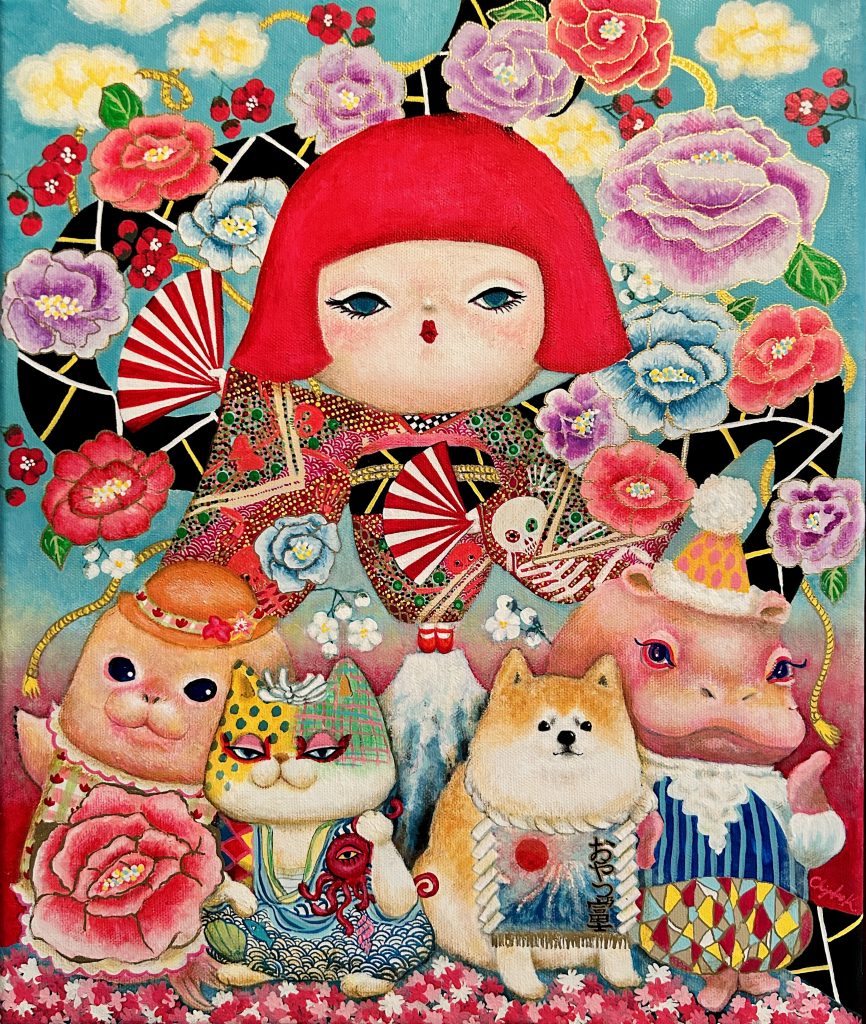
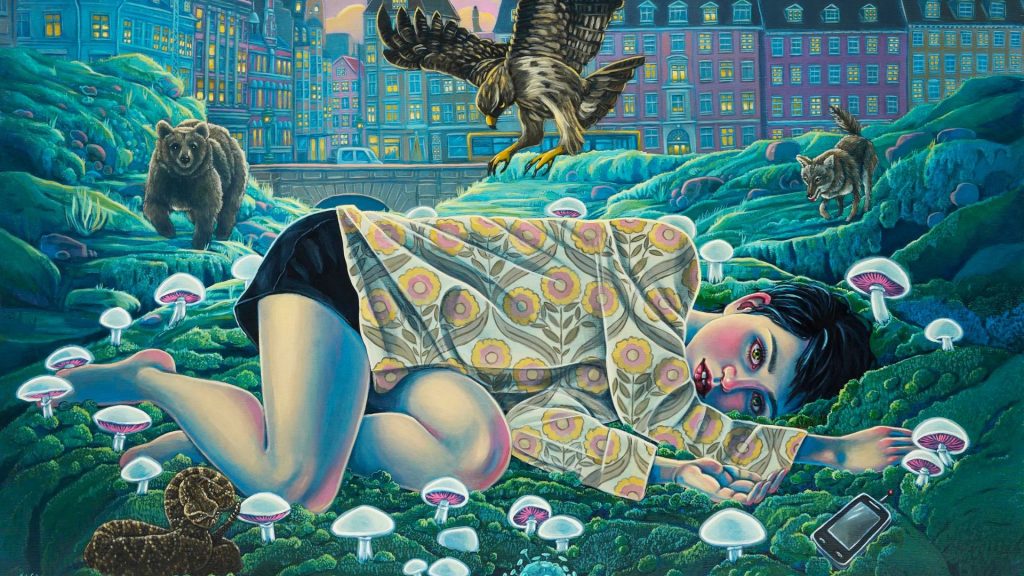
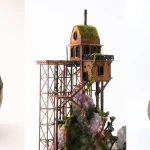
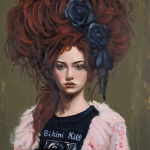
They call themselves The Crimson Orchard now. Before that, they were two tattoo artists who happened to fall for each other and discovered, somewhere along the way, that their imaginations had already been circling the same myths for years. Below, they talk about clay, colored pencils, what it’s like to lose your individual identity in a good way, and the advice they’d give anyone dumb enough (their word, basically) to try making art a career.
As your work is a collaborative entity, do the individual parts of yourselves live clearly inside the work, or has the collaboration evolved into something that exists beyond either of you independently?
It has definitely become its own entity. It’s maybe a bit cliche, but we have had the same artistic vision before we became a couple, or even before we met. We inspired each other from afar and when we met it literally felt like you have finally met that being that has (unbeknownst to you) co-written your personal dictionary of your visual, emotional and artistic language.
when we started, we kept each of our work clearly separated. It felt weird and almost against our nature. So now, that we don’t even sign our pieces with our individual names anymore, everything makes sense and became so fluid. We are very much each other’s muse, student and teacher at the same time.
To be honest it’s hard to see each other as individual or a collaborative artistic entity. We kind of exist as one, only really becoming two, when situations or circumstances make it necessary. And funnily enough, even though this can be understood as a huge dependence, it really is quite the opposite, as we both know exactly how the other would feel, react and work, which leaves so much room for everything else other than discussions, finding compromises and pushing our own ego.
And that is truly magical, and incredibly freeing for each other’s inspiration and imagination. One of the most healing side effects after years of self-doubt and self-criticism, is probably the love we developed for our own work, since both of us are so involved in the process of every single piece.

Your work leaves room for uncertainty, symbols, and interpretation. Do you think mystery has become more important in an era of constant visibility particularly in the visual arts in the digital age?
We believe that there have always been forces to keep people from thinking on their own and asking questions. In times of AI taking over and everything being so readily available, but full of half-truths and half-information it’s necessary to train our minds and souls to see beyond the tangible and start experiencing more with all our senses. Mystery offers room for imagination, originality and inventiveness. In an age when technology is set to make people dumber and dumber, and more removed from what the intuition, wisdom and power they hold in themselves, it’s so important to try and spark a thought process. It’s sadly never been easier to stay stupid and oblivious. To us, art has always been, and always will be political.

The work often feels less like isolated pieces and more like evidence from a larger hidden mythology. Was there a point when creating a shared world became more important than creating individual images or was it intuitively unified from the beginning?
It was like that pretty much from the begging. Victoria, who always had a strong sense of storytelling, and creating artworks which clearly housed a narrative, has been studying and researching European history since childhood and therefore is heavily inspired by that, intertwined with mythicism and the occult. This is something Evelyn was also using in her own work before we met. So the transition into our shared work, as described before, was easy and very natural. The stories, emotions and lore that plays out in our work very rarely collide with each other, and everything coexists in our universe simultaneously.

What are the mediums that you love to use the most and why? Any favorite brands or tools?
We both started our artistic journey with traditional media. And while we have a quite impressive collection of art supplies we hoarded over the years (we jokingly call it our „In-house Art Supply Store”), working with clay became our medium of choice. The way it literally grounds our bodies, minds and nervous system to an extent we can hardly describe.
It became our safe haven and almost has meditative values to it. We used to work almost exclusively with our iPad for our job as tattoo artists, which is in such stark contrast to digging your hands into mud. We’ve never stopped using our traditional mediums like watercolour, coloured pencil, graphite and gouache. A lot of brands even have a very nostalgic feeling to us, others that we discovered in the last years give us a new momentum. Caran d’Ache lumiance, Derwent drawing, Holbein and Faber-Castell Polychromos are our most used colour pencils, and we’re obsessed with the quality of the watercolours by Deep Deep Light and A.Gallo.


There also appears to be a visual language that drifts between the worlds of fine art, tattooing, historical symbolism and nostalgic emotion. How do the different aspects of your creative lives find and influence each other?
Tattooing has become less and less of a creative source and artistic influence for us. It is a scene that is most often loud, self-promoting and needs you to be extroverted to fit in. We have been working in the industry for quite some time, and never truly found our home there, no matter how hard we tried to fit in. But this is not us, or what we feel we need.
Our shared visual language feeds from the lifestyle we seek out, and the bubble we create with „The Crimson Orchard“, not only for us as artists but for the atelier we’re building together, and everyone who wants to join in.
Living a spiritual life that is more in touch with nature, our minds and the arcane, forms a lot of what we want to observe, learn from and express in our work.
It seems almost self-explanatory to us that specifically nostalgia in all its aspects is our escapism of choice in a world that is often too loud, too fast, too uncertain, too technological and too much out of our control to endure, without ever neglecting the obvious comforts and cultural and political awareness of the modern world.
The visual world you have created feels emotionally intimate while still withholding clear explanations. What do you think people reveal about themselves when they try to interpret ambiguous imagery and can you share a little about how you have heard your work being interpreted by others?
This is a topic we talk about a lot! More often than not people might just be drawn to a specific piece for aesthetic reasons, and only after some time realise that their subconscious has been called by the underlying meaning of the artwork. We love to hear how people feel touched, confronted, supported, inspired and seen by what we do. Unsurprisingly, it is usually those pieces that were a therapeutic experience for us to create that others have deep feelings about, too. And with those, they really get our motivation and meaning behind it pretty spot on. Of course, not everyone has the same experiences and traumas that we have, but the emotions and life lessons that grow from these, and the expectations of how to go from there are shared and offer a common ground for communicating visually and emotionally. And that’s exactly what we’re trying to achieve.
We have a thing for oversharing...
New artist interviews, articles, books and more!
What advice would you give an artist starting out (at any age) who wants to do it professionally?
It’s easy to fall into the trap of “producing” instead of actually creating, when you have to make ends meet financially, but it’s very important to never leave your message and essence out of focus. Without that art becomes a meaningless product very quickly, and you’ll loose your spark, which inevitably will leave you drained and burnt out.
With that being said, it’s crucial you take yourself and what you have to offer seriously, while not expect instant success and making a lot of money right away. Like with everything, money should never be the motivator.
In our own experience, there will always be people to feed into your imposter syndrome in asking for discounts, or make you feel like even charging the bare minimum is too much. Sticking to those who lift you up, support you and show up when they don’t have to but want to is in our opinion essential in sticking to the path of making art, or any type of calling, your profession.


Deborah Jackson, Gallery Assistant
Deborah Jackson is the Gallery Assistant for Poetic Tiger. She is also an artist and writer who creates big-eyed characters with soft, brave, gentle hearts. Living now on a wild and windswept island in Scotland, her work is for those who feel the deep pull of small magic and look to immerse themselves in stories filled with curiosity and courage.